
How I (mostly) overcame Plantar fasciitis
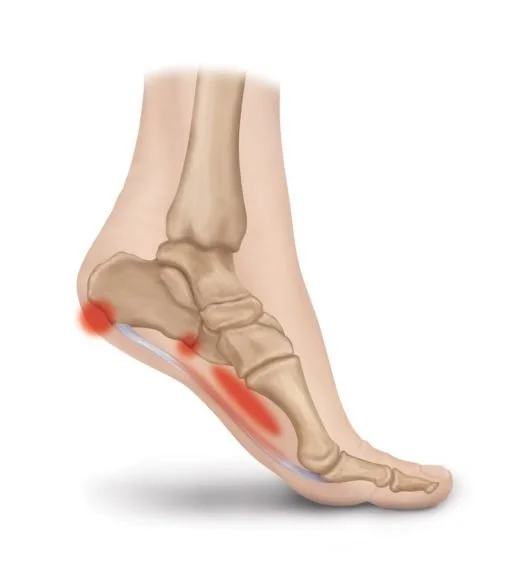
This past week someone in my facebook feed was asking for advice from the internet about what to do for plantar fasciitis when everything else she had tried had failed. I thought this would be a great opportunity to talk about my own struggles with this pain and what I have learned to be helpful along the way. I know so many people who struggle with this and its about time I put it all down to share.
First let me tell you about my own struggles. I actually first was diagnosed with PF as a teenager. I grew up as a child walking like a barbie doll on the balls of my feet with invisible stilettos. In highschool, I started getting severe foot pain. I attribute it to a couple things - I had a part time job as a cashier where I was standing for long hours, I ran track and was putting additional stress on my feet, but mostly I think I was teased enough by my peers that I started to walk flat footed which my body just wasn’t used to. I went through the usual channels - I got orthotics and mostly suffered through it - ahh to be that young again. A few years go by and high heels were in style and more age appropriate. My feet were so happy and I could rock those big heels like nobody’s business.
Then in 2019 I started noticing an unusual pattern. I was spraining my ankle a lot. I would be walking or running and take a funny step and my left foot would brush the inside of the right and the right would just give out and down I went! I noticed an extra bump on the inside of my ankle. Now I already have more bumps there than normal as I have an accessory navicular (an extra navicular bone in my foot), but this one wasn’t like the others.
In January 2020, I had surgery to remove a large (benign thankfully) tumour that had been growing from the nerve. Who would have thought ankle sprains would be the symptom of tumours! I guess when my foot or even my shoe had rubbed it, it would trigger the nerve. Close to the surgery, I would even notice it would happen if I just flexed more than 90 degrees. With the surgery however, they had to take out part of the nerve along with it. I went about recovery as prescribed, going to physio and doing all the things to get me back to where I would be discharged, but I was still far from normal.
Still in 2026, I don’t have complete feeling in the bottom of my foot. For a while, it didn’t bother me. As one of my friend’s said “one less thing to hurt during a 100” as I actually did my first 100 mile competition that year! From the outside, recovery looked good. I could flex my ankle enough to get in the stirrups and I could even run again if I didnt care that I couldn’t feel the ground beneath me.
What was happening underneath however, was something I would never expect - with the loss of that nerve, I had almost no muscular control of my foot. Very gradually, my foot shape changed dramatically. It became so tense that the lightest movement would strain or even tear the plantar muscles. I did all the things I had done previously, but it wasn’t working. I couldn’t get out of bed in the morning without a 20 minute pep talk. I couldn’t stand at the counter long enough to chop veggies for dinner. I remember dismounting one night from a short bareback ride, and just that little drop to the ground had me fighting back tears. I couldn’t do much of anything. I was in and out of physio the whole time, it would work for a bit, but I would always end back up where I started. Like many people I see, I tried what I thought was everything and I was never getting better.
Now, here I am in 2026 and I can say with confidence that I finally feel the closest to my former self than I have in 6 years, and I haven’t been afraid to get out of bed for almost a year now which is the longest streak yet. I am even cautiously getting back into running and haven’t had any issues increasing my mileage. Here are some of the things I have been doing differently this past year that I believe have contributed to my progress.
1) I stopped expecting to get better.
This may sound crazy or depressing, but it was an important mindset shift. Instead of thinking I would go to physio and after my course of treatment that I would be fixed, I realized that this is just my life now. No, the pain doesnt have to be my life now, but the exercises I assigned were. Even if I feel good, I dont assume I am fixed. I know my foot is technically a disability, and I do what I need to in order to support it. I do my exercises on the bad days and the good. I have worked with enough physiotherapists now to know that most people dont even do their exercises at home. They were always impressed by my committment, but I had to take it to yet another level. I had to adjust my identity to be someone who shows up consistently to keep my body tuned.
2) I ditched orthotics, and sometimes shoes entirely
I realized that orthotics weren’t actually helping. They act like a cast on the foot. While they may give you added support, they do nothing to improve the strength and mobility of the foot. In fact they do the opposite. I spent more time walking outside barefoot wherever I could. I walked over different surfaces and uneven ground. I actually think this one really clicked when I learned to barefoot trim horses. I learned about how the steel shoes restrict the hooves, how structures of the hoof should come into contact with the ground in order to be healthy, how it might be uncomfortable at first but small changes add up over time. Why wouldn’t the same thing apply to our feet?
3) I strength trained HEAVY (while barefoot)
This one sounds really crazy, but I actually think this has one of the biggest impacts for me. I have always strength trained at my home gym but I was limited in my equipment. I joined a gym and hired a personal trainer (yes even though I am a trainer, I also benefit from having a trainer!) and focused on increasing my big lifts. I started lifting with shoes but actually ditched them when I was noticing my form got worse with the extra cushioning. Not having the “support” of my shoes has helped me to learn to better use my feet, and gain some strength in them. I use my trainers and video feedback to see what my feet are doing as I go up in weight. If I am pronating or supinating, I consciously adjust my feet to better support me. Increasing the weight gives me purpose and direction, and my feet continue to get stronger. I may be the crazy person in the gym walking around in my socks in the gym, but nobody seems to mind so I have gotten over being embarrassed by it - I have my reasons! Plus my massage therapist tells me “serious lifters” all lift without shoes. Guess that makes me serious!
4) Ride more (trot)
The one other time my feet felt the best prior to this point was when I did the Marcha di Resistencia in Brasil. 750km of riding in 15 days. After I came back, I had virtually no pain in my feet. I discussed it with my massage therapist (who has also dabbled in endurance riding on my horses) our theory was that because I had spent so much time with my foot flexed in the stirrup, I got a really deep, long stretch through my foot. Now, this was one that didn’t “fix” the problem, but I do notice the more I ride, the better my feet feel. And I know this is an easy one to convince you to do! What is important to note here is not that you need to do 6+ hours of saddle time, 15 days in a row, but repeating the things that are helping just like in point #1.
I hope this has been helpful for you if you have been suffering with PF. The bottom line through all this is that the biggest movers have been putting in all that consistent work on the basics and being patient. No device or pill is going to give you the long term effect you are looking for. Much like the dressage greats spend the majority of their time drilling the walk and the 20m circles, so must we work on the boring, repetitive actions that truly move the needle.
And to continue the dressage analogy, we cant expect to be riding Grand Prix in weeks, months or even years. We must expect to fail many times with trial an error, but never give up. So cheers to the slow, steady and boring work we put in every day.
I am going to leave you with my daily routine for my ankles and feet. Enjoy!
-Sarah
P.S. You all know it but I will state it again for those in the back: I do offer one-on-one personal training! While its tailored more to building strength through the whole body, if you are a rider and you suffer from PF we definitely have a lot in common! I cannot take the place of a good physiotherapist, but I can help support your program to heal your feet and get you strong and resilient for the saddle! You can send me an email to chat more about how we can work together.