
Equestrian & Skiing = samesies?
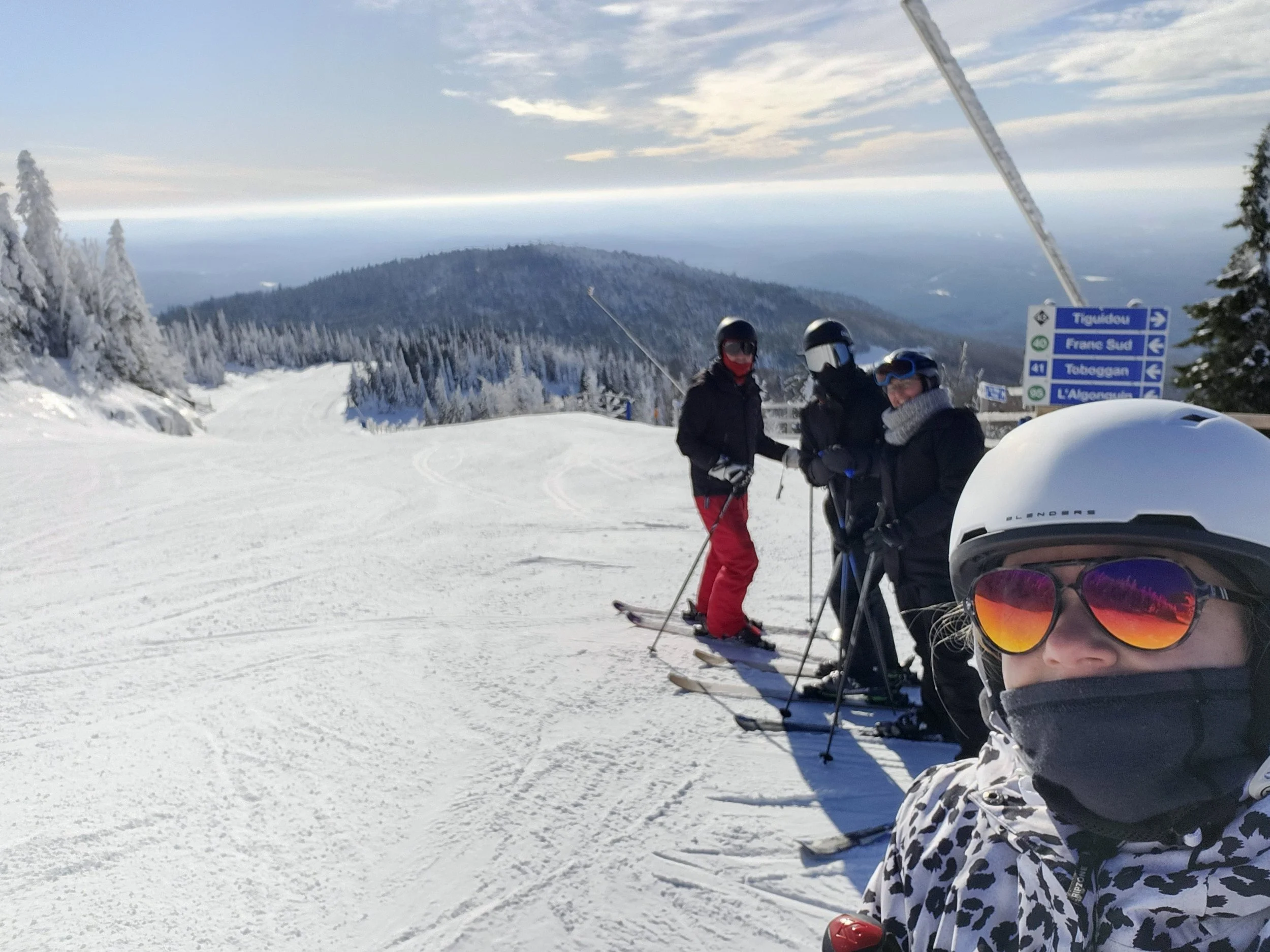
As I type this, I am on my couch sipping coffee and watching the Olympic alpine skiing. I have just returned from a vacation to Mont Tremblant, Quebec where I skied for 3 days and managed to get over 110km of skiing in during that time. I am an average skier, the hills around here aren’t particularly large, but I can get down most of them, I spend most of my time on the greens and blues and I really enjoy myself.
During my trip, and again when watching the Olympics, I found myself thinking about how skiing and riding have a lot of commonalities, and how many equestrians I know that ski as well. The more and more I think about it, most of my friends and clients ski in addition to riding (though riding is absolutely their primary sport). Now maybe I have attracted a certain subsect of riders who also ski because we have similar personalities, but its enough of a pattern that I wanted to comment on it.
First off, I think it is so healthy for us to ski. Riding is a great sport but it tends to consume us. Having another activity is good for our minds and bodies. It gives our horses a break when they need it and gives us an identity out of riding. Many times I see riders hit plateaus in their training or slide backwards and get incredibly depressed because their identities are entirely wrapped up in the sport, their horse, or their goal (particularly with riders who are shooting for big things like the Mongol Derby). Having another sport where you can accrue small wins is good for your confidence and mental state. I say the same thing about weight lifting… while the physical benefits are clear for riders, often the biggest impact is the confidence ripples that come from lifting heavy things you didn’t think you could!
Here are a couple more thoughts that came to my mind on how skiing is similar and different to riding.
Same: Squat is a valuable tool
Both sports require significant leg and glute strength. Squats are your friend here! It isn’t about having the deepest squat or the heaviest squat, but doing it right by hinging at the hips and keeping bodyweight centred over your feet. Practice this and grow your confidence using a chair or bench behind you for support. I found my squat particularly helpful when I hit the long stretches of flat at the bottom of the green runs, I could hold it long enough that I didn’t have to “stick” my way through them. I mean, using your poles is a great upper body workout too, but I found great satisfaction in outsquatting every skier around me!
Different: Inside vs outside of legs
I found as I was skiing that I am using a lot more of the outside of my leg than any other part of the leg. When we ride, we tend to use the inside of our legs to grip and stay upright. When I train riders, I end up training a lot of the outside of the leg to bring balance to the leg and offset all that squeezing. What a perfect complimentary exercise! But beware, if you dont do much skiiing, this will probably be weak and wear out first. Dont be afraid to add some banded lateral work to train this. As I said, this will help balance your body from riding as well which will help with knee pain down the road too!
Same: Let the equipment move you
On the first day I was skiing, my feet hurt so much in my boots on the outside of my feet. On day 2, I noticed I was really pushing into them, it was like I was trying to move the ground underneath me. I was working WAY too hard. Once I started letting the skis do their job, I was able to do more with less. Same thing can happen with our horses and when I take people out for long trots, I see the transformation. At some point in time they get tired, and stop using their bodies and sheer strength to move them, and they use the movement of the horse to lift their bodies and ride more efficiently. The only thing you get from working harder is more tired! Figuring out this movement BEFORE you are tired will help keep you on the horse or hill longer with better quality throughout.
Different: Weight forward vs weight back
One thing I really had a hard time with was where my weight should be while skiing. In riding, we want our weight back. Shoulders back, chest out, its safer to be behind the movement a little if you overdo it. My friend pointed out to me that I need to be more forward over my skis to have the control I needed. Putting my weight on the back of my boots was contributing to the above problem and making me braced, which wouldn’t allow me to absorb the changes in terrain. I should be having shin pain from boot pressure, not calf pain! Wow was this ever a difficult thing to overcome having years of “shoulders back” drilled into me. I think this is another place where weight training can help - not in a specific way, but simply moving the body and working into different positions than we are used to - and noticing when you are getting stuck somewhere and being able to change it! Weight training gives us a lot of proprioception which gives us the ability to put our body wherever it needs to be based on the task at hand.
Same: Look where you want to go
As I watched the Olympic skiing from the comfort of my couch, the announcer made mention of looking down at your skis being a recipe for disaster. Of course, my ears perked up having heard “eyes up” somewhere in the realm of 10,000 times from riding coaches through my riding career. Where you look has a huge impact on your balance and body control. In the weight room, this still matters. Eyes up vs down will change your posture and can mean the difference between a well executed lift vs one that in the best case scenario, is less than you had hoped for, and the worst case scenario can actually injure. If you want to practice this in the weight room, pick a light weight to work with, get halfway into your lift, pause, and then change your eyeline and feel what that does to your body, bring your eyes back to where you feel strong and balanced, then continue on with the movement.
Same: Move body parts independently
I previously mentioned how braced I started out when I was skiing, I didn’t trust my skis to take me where I wanted to go. As a result, I looked a bit like a figurine going down the hill. When I wanted to turn, everything turned and my body didn’t change much. What I needed to do was separate the body parts. The feedback I received from a friend was the upper body points where I want to go (down the hill) and the legs follow the current path. They should essentially be working independently (though not TOO independently). As I started to get better at this, I also noticed that I could also add in the left and right independence for better turns, tilting just one ankle to catch my edge and initiate my turns instead of leaning my whole body and a few other small tweaks here and there. This reminded me so much of riding where sometimes we want to move a leg to a certain spot, drop just one seat bone, or lift a single hand but have the rest of our body remain steady. Working out in the gym offers us an opportunity to spend some time connecting with different parts of our bodies to teach them to move independently, in a safe environment where we don’t have to worry about falling down the hill or our horses reaction. This is a mind exercise more than anything, you can apply to any exercise in the gym just by slowing down and noticing what parts of you move and seeing if you lock something up, can another thing still move? However, if you want an assignment that really helps you feel this, anything where you are adding movement to a plank, such as a renegade row, is my go to.
Same: Strength is safety!
Back to the Olympics, the skiers are flying around the turns at 100km/hr+ and in the course of me writing this, there have been SEVERAL crashes. Both skiing and riding can be very dangerous sports. One skier in particular got particularly behind the motion, but managed to get herself out. The announcer commented that in order to do this, the skier must have incredible core strength to come back from that bobble. The skier recovered and finished a nice round. My thoughts flash back to the summer where I was breaking a horse for a charity challenge that I do annually. As I mounted the horse reared several times, walked on her hind legs, bolted, spun, crow hopped. Nearly all the dirty tricks you can think of. What was remarkable was I started off with my feet above my head and my butt behind the saddle, and I managed to stick it out through all that, come upright, and bail to the side when I was confident I would land on my feet and not my helmet. I don’t think I could have made that choice if I wasn’t physically very strong. Even the best horses can be unpredictable and a trip or spook can put us in a vulnerable position. Being able to get out of the vulnerable position and or control your fall is HUGE for your safety. While nearly all lifting will help you get there, you can also practice putting yourself in a vulnerable position and getting out. I love a single leg deadlift for this as the most vulnerable position for riders is bent over forward. Start with support (the video shows suspension trainer but you can do beside a chair or wall to grab) and gradually work to doing it without support.
So there you have it, some of the ways that I thought skiing was like riding and some of the exercises you can do that I think would improve both. Cross training is an incredibly valuable tool for athletes. If you are anything like me, you probably also think “this is just like riding” whenever you do seemingly unconnected sports. Aside from giving our bodies and horses a break, cross training teaches us valuable lessons about our bodies and our minds.
Do you cross train or do other sports? Let me know in the comments what you do outside of riding and what it has taught you!
Until next time, happy riding and skiing!
-Sarah